बर्बरीक
Barbarik
Khatu Shyam Ji: The Story of Barbarik and the Names of Shyam Baba
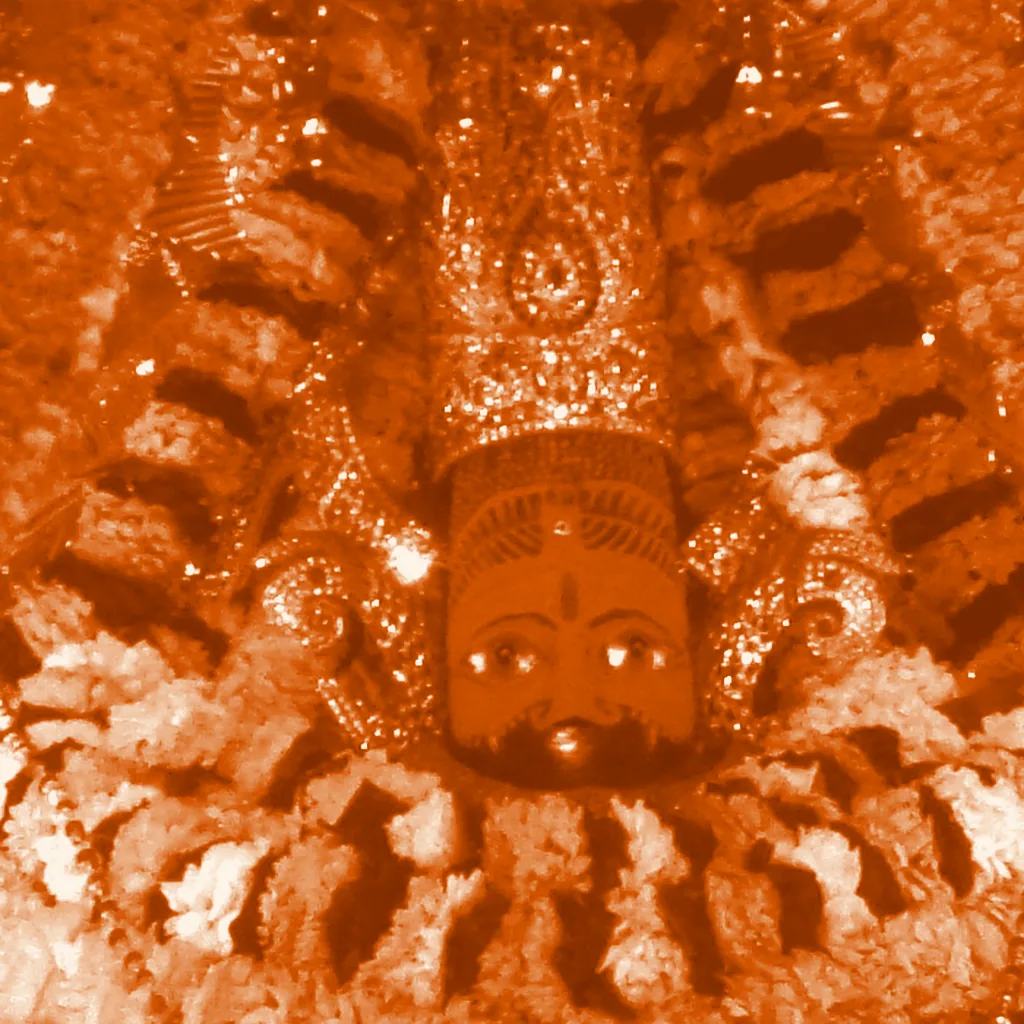
Khatu Shyam Ji, Shyam Baba, Haare ka Sahara: the names belong to one figure, Barbarik, who in the tradition of Rajasthan and Haryana gave his head to Shri Krishna before the war of the Mahabharata and received the boon that in the age of Kali he would be worshipped by Krishna's own name. His head is enshrined in the temple at Khatu in Sikar district, Rajasthan, and millions come to it each year.
This page tells the story as the tradition tells it, from Barbarik's birth to the temple at Khatu, and then gives the names devotees call him by, each with the part of the story it comes from. The same eleven names are the answers of the Khatu Shyam Prashnavali on this site.
Ask the Khatu Shyam Prashnavali
The Names of Shyam Baba and What They Mean
Name 1
His birth name. Son of Ghatotkacha and Maurvi, grandson of Bhima, bound by his vow to fight only for the side that was losing.
Name 2
शीश के दानी
Sheesh ke Daani
Sheesh ke Daani
The giver of his head, which he gave to Krishna before the war without hesitation, asking only to watch it to its end.
Name 3
हारे का सहारा
Haare ka Sahara
Haare ka Sahara
The refuge of the defeated: Krishna's boon that whoever comes to him after losing everything will find support.
Name 4
तीन बाण धारी
Teen Baan Dhaari
Teen Baan Dhaari
The bearer of three arrows that could not miss, with which he could have ended the war in moments.
Name 5
लखदातार
Lakhdatar
Lakhdatar
The giver of lakhs: devotees say what he gives he gives in abundance, asking nothing but faith.
Name 6
खाटू नरेश
Khatu Naresh
Khatu Naresh
The king of Khatu, where his head appeared and where the temple has stood since 1027.
Name 7
मोर्वी नंदन
Morvi Nandan
Morvi Nandan
Son of Maurvi, who taught him the art of war and took the vow from him.
Name 8
लीले का असवार
Leele ka Asvaar
Leele ka Asvaar
The rider of the blue horse, whose figure flies on the temple's nishan.
Name 9
मोरछड़ी वाला
Morchhadi Wala
Morchhadi Wala
The one with the peacock-feather whisk, Krishna's own mark, carried as the sign that he is Krishna's by name and by grace.
Name 10
कलियुग का अवतार
Kaliyug ka Avtaar
Kaliyug ka Avtaar
The deity of this age, placed in the age of Kali by Krishna's boon for the people of this time.
Name 11
श्याम
Shyam
Shyam
Krishna's own name, given to him with the boon: the name by which he is worshipped at Khatu.
The Story of Barbarik
In the tradition, Barbarik was the son of Ghatotkacha and Maurvi, also called Kamkatankata, and so the grandson of Bhima. He learnt the art of war from his mother, who made him promise that he would always fight for the side that was losing. The Goddess gave him three arrows that could not miss: with one he could mark every target, with another everything to be spared, and with the third destroy all that was marked. The story is a folk tradition that grew around the Mahabharata rather than a part of the epic's own text, and devotees hold it as such.
When the war at Kurukshetra was about to begin, Barbarik set out to watch it, intending to join the weaker side. Shri Krishna, who understood that a warrior bound to the losing side would end the war in moments and leave no victor, met him on the way in the form of a brahmin. He tested the three arrows against the leaves of a tree, hiding one leaf under his foot, and the arrow found that leaf too. Then he asked Barbarik for a gift, and when Barbarik agreed, asked for his head.
Barbarik gave it, asking only to watch the war to its end. Krishna placed the head on a hilltop, and from there Barbarik saw the eighteen days. When it was over and the victors argued over whose valour had won, it was the head that answered: it had seen only Krishna's chakra fighting. Krishna then gave the boon by which he is worshipped today, that in the age of Kali Barbarik would be known by Krishna's own name, Shyam, and that whoever came to him defeated would not go back empty-handed.
How the Head Came to Khatu
Long afterwards, the tradition says, the head appeared at Khatu, in what is now Sikar district of Rajasthan, at a spot where a cow would come each day and let down her milk. The head was found there and was given into a brahmin's keeping, and the ruler of the place was told in a dream to build a temple and enshrine it. The first temple is believed to have been built in 1027 by Roop Singh Chauhan and his wife Narmada Kanwar, and it was rebuilt in 1720 by Abhay Singh, the diwan of the Thakur of the place.
A second temple of Shyam Baba stands at Reengus, about seventeen kilometres from Khatu on the road from Jaipur, which is also the nearest railway station. Khatu itself is about eighty kilometres from Jaipur.
Fairs, Ekadashi and the Nishan
The great fair at Khatu is held every year around the Ekadashi of the month of Phalgun, when devotees walk to the temple from across Rajasthan, Haryana and beyond, and every month's Ekadashi draws its own crowd. Shyam Baba's birthday is kept on Devuthani Ekadashi in the month of Kartik. Janmashtami, Gyaras and Diwali are also celebrated at the temple.
The flag on the temple's spire, the nishan, has its own story. It is prepared each year at an old temple in Surajgarh in Jhunjhunu district, white cloth bearing the figure of the blue horse, and is carried to Khatu during the Phalgun fair and raised on the spire for the year. Devotees carry their own nishans on foot to the temple as an offering.
Frequently Asked Questions
Who is Khatu Shyam Ji?
Barbarik, grandson of Bhima, who in the tradition gave his head to Shri Krishna before the Mahabharata war and was granted that he would be worshipped in the age of Kali by Krishna's own name, Shyam. His head is enshrined at Khatu in Sikar district, Rajasthan.
Why is he called Haare ka Sahara?
The refuge of the defeated: Krishna's boon was that whoever comes to Shyam after losing everything will find support and will not go back empty-handed.
Where is the Khatu Shyam temple?
In Khatu village, Sikar district, Rajasthan, about eighty kilometres from Jaipur. The nearest railway station is Reengus, about seventeen kilometres away, which has a temple of Shyam Baba of its own.
When is the Khatu Shyam mela?
Every year around the Ekadashi of the month of Phalgun, in late winter, with smaller gatherings on every month's Ekadashi. His birthday is kept on Devuthani Ekadashi in Kartik.
What does Sheesh ke Daani mean?
The giver of his head: the name recalls the gift Barbarik made to Krishna before the war, asking only to watch it to the end.
If you have come to Shyam Baba with a question of your own, the Khatu Shyam Prashnavali on this site lets you choose a number and read one of these eleven names as your answer, with its story and a reading of whether the matter is favourable.
Ask the Khatu Shyam Prashnavali
The verses are traditional texts; the explanations are the site's own words, offered for reflection, not as a guarantee of any outcome. Privacy Policy.
Image: Shyam Baba at the Reengus temple, photograph by Wikimedia Commons user Shyam, CC BY-SA 3.0, cropped and recoloured in the site's palette; this image is shared under the same licence.