वन्दे वाञ्छितलाभाय चन्द्रार्धकृतशेखराम्।
वृषारूढां शूलधरां शैलपुत्रीं यशस्विनीम्॥
Navadurga: The Nine Forms of Durga with Their Mantras
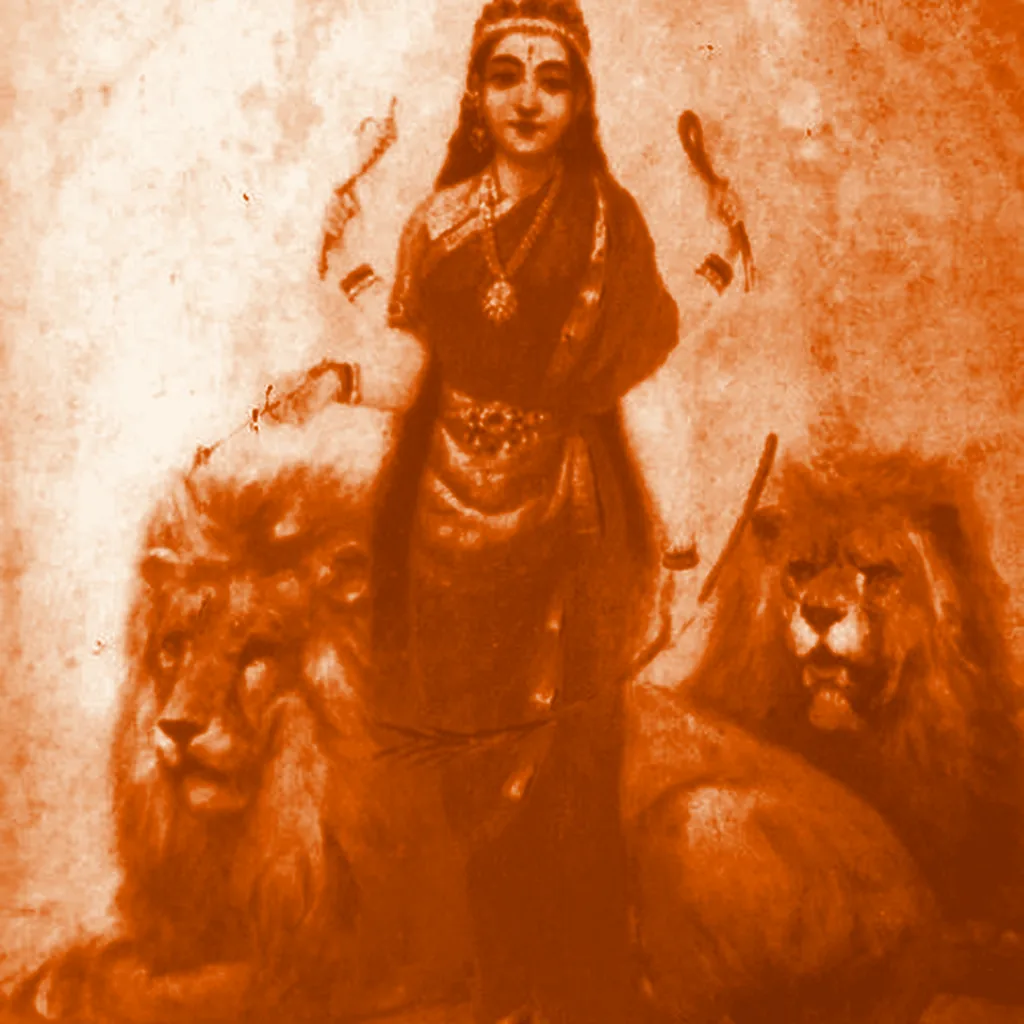
Navadurga means the nine Durgas: the nine forms of the Goddess worshipped one on each of the nine nights of Navratri, in the order Shailaputri, Brahmacharini, Chandraghanta, Kushmanda, Skandamata, Katyayani, Kalaratri, Mahagauri and Siddhidatri. The order is itself a story, from the daughter of the mountain who comes to Shiva, through penance, battle and the dark night, to the giver of every accomplishment.
This page gives each form in order with the verse recited for her, the dhyana mantra, in Sanskrit with a plain meaning in English, what she looks like, and what devotees ask of her. The same nine verses are the answers of the Durga Prashnavali on this site, where a number you choose leads to one of them.
The Nine Forms, Their Mantras and Meaning
Day 1: Shailaputri
I bow, for the gain of what is wished for, to the glorious daughter of the mountain, the half-moon on her crown, riding the bull, the trident in her hand. She is Parvati born as the daughter of Himalaya, and devotees ask her for a firm beginning.
Day 2: Brahmacharini
दधाना करपद्माभ्यामक्षमालाकमण्डलू।
देवी प्रसीदतु मयि ब्रह्मचारिण्यनुत्तमा॥
देवी प्रसीदतु मयि ब्रह्मचारिण्यनुत्तमा॥
May the supreme Goddess of penance, who holds a rosary and a water-pot in her lotus hands, be pleased with me. She is Parvati in the years of austerity by which she won Shiva, and devotees ask her for discipline and patience.
Day 3: Chandraghanta
पिण्डजप्रवरारूढा चण्डकोपास्त्रकैर्युता।
प्रसादं तनुते मह्यं चन्द्रघण्टेति विश्रुता॥
प्रसादं तनुते मह्यं चन्द्रघण्टेति विश्रुता॥
Riding the finest of lions, armed with weapons and fierce in anger, she who is famed as Chandraghanta spreads her grace over me. She wears a bell-shaped half-moon on her brow, and devotees ask her for courage.
Day 4: Kushmanda
सुरासम्पूर्णकलशं रुधिराप्लुतमेव च।
दधाना हस्तपद्माभ्यां कूष्माण्डा शुभदास्तु मे॥
दधाना हस्तपद्माभ्यां कूष्माण्डा शुभदास्तु मे॥
May Kushmanda, who holds in her lotus hands the pot brimming with nectar, be the giver of good to me. With her smile she brought forth the cosmic egg, the universe itself, and devotees ask her for abundance and new beginnings.
Day 5: Skandamata
सिंहासनगता नित्यं पद्माश्रितकरद्वया।
शुभदास्तु सदा देवी स्कन्दमाता यशस्विनी॥
शुभदास्तु सदा देवी स्कन्दमाता यशस्विनी॥
May the glorious Goddess Skandamata, ever seated on the lion throne with a lotus in each hand, always be the giver of good. She is the mother of Skanda, Kartikeya, and devotees ask her for the welfare of children and family.
Day 6: Katyayani
चन्द्रहासोज्ज्वलकरा शार्दूलवरवाहना।
कात्यायनी शुभं दद्याद्देवी दानवघातिनी॥
कात्यायनी शुभं दद्याद्देवी दानवघातिनी॥
May the Goddess Katyayani, the bright sword Chandrahasa in her hand, riding the finest of tigers, the slayer of demons, give good. She was born of the sages' fire to end Mahishasura, and devotees ask her for victory over what opposes them.
Day 7: Kalaratri
एकवेणी जपाकर्णपूरा नग्ना खरास्थिता।
लम्बोष्ठी कर्णिकाकर्णी तैलाभ्यक्तशरीरिणी॥
वामपादोल्लसल्लोहलताकण्टकभूषणा।
वर्धन्मूर्धध्वजा कृष्णा कालरात्रिर्भयङ्करी॥
लम्बोष्ठी कर्णिकाकर्णी तैलाभ्यक्तशरीरिणी॥
वामपादोल्लसल्लोहलताकण्टकभूषणा।
वर्धन्मूर्धध्वजा कृष्णा कालरात्रिर्भयङ्करी॥
A single braid, a hibiscus at her ear, riding a donkey, her body anointed with oil, iron thorns as her ornament, her hair streaming like a banner, black and terrible to look upon: this is Kalaratri, the dark night. Devotees call her Shubhankari, the one who brings good, and ask her to end fear and every darkness.
Day 8: Mahagauri
श्वेते वृषे समारूढा श्वेताम्बरधरा शुचिः।
महागौरी शुभं दद्यान्महादेवप्रमोददा॥
महागौरी शुभं दद्यान्महादेवप्रमोददा॥
May Mahagauri, pure, seated on a white bull and dressed in white, the giver of joy to Mahadev, give good. She is the brightness after the dark night, and devotees ask her for peace and purity.
Day 9: Siddhidatri
सिद्धगन्धर्वयक्षाद्यैरसुरैरमरैरपि।
सेव्यमाना सदा भूयात् सिद्धिदा सिद्धिदायिनी॥
सेव्यमाना सदा भूयात् सिद्धिदा सिद्धिदायिनी॥
May Siddhidatri, the giver of accomplishment, served always by siddhas, gandharvas, yakshas, asuras and gods alike, grant accomplishment. She is the ninth and last form, and devotees ask her for the completion of what they began.
Where the Nine Names Come From
The nine names in this order are listed in the Devi Kavach, the protective hymn recited before the Durga Saptashati: first Shailaputri, second Brahmacharini, third Chandraghanta, fourth Kushmanda, fifth Skandamata, sixth Katyayani, seventh Kalaratri, eighth Mahagauri, ninth Siddhidatri, these nine Durgas were proclaimed by Brahma himself. The dhyana verses given above are the traditional verses recited for each form on her day.
The nine forms are read as one life of the Goddess. Shailaputri is Parvati born as the mountain's daughter. Brahmacharini is her years of penance to win Shiva. Chandraghanta is the bride with the half-moon bell on her brow. Kushmanda is the mother of the universe. Skandamata is the mother of Kartikeya. Katyayani is the warrior born of the sages' fire to end Mahishasura. Kalaratri is the night that destroys all darkness. Mahagauri is purity after the battle. Siddhidatri is fulfilment.
Navratri and the Nine Days
Navratri comes twice a year: Chaitra Navratri in spring, in the month of Chaitra, and Sharad Navratri in autumn, in the month of Ashwin, which ends with Vijayadashami, the day of Durga's victory. On each of the nine days one form is worshipped, in the order above, with her mantra recited before the day's puja. The eighth and ninth days, Ashtami and Navami, are the most widely kept, and many households worship young girls as the Goddess on one of them.
The mantras are not limited to Navratri. Devotees recite the verse of a form whose quality they need, Brahmacharini for discipline, Katyayani for courage, Mahagauri for peace, on any day.
How the Mantras Are Used
Each dhyana verse is a picture in words. It is recited while holding the form in mind, before the chapter of the Durga Saptashati for the day or before a simple offering of flowers and a lamp. Read it slowly, let the picture form, and then make your request. The Goddess in each verse is already doing what you are about to ask for.
Frequently Asked Questions
What are the nine forms of Durga in order?
Shailaputri, Brahmacharini, Chandraghanta, Kushmanda, Skandamata, Katyayani, Kalaratri, Mahagauri and Siddhidatri, worshipped on the first to the ninth day of Navratri.
Which form is worshipped on which day of Navratri?
One form per day in the order above: Shailaputri on the first day, Brahmacharini on the second, and so on to Siddhidatri on the ninth.
Are the Navadurga mantras from the Durga Saptashati?
The nine names in order are listed in the Devi Kavach that is recited with the Saptashati. The dhyana verses for each form are the traditional verses recited on her day.
Can the Navadurga mantras be recited outside Navratri?
Yes. Devotees recite the verse of the form whose quality they need on any day; there is no restriction.
Why is Kalaratri called Shubhankari?
Because the darkest and most fearsome form is held to bring good: the night that frightens is the night that ends every other darkness, and what follows it is Mahagauri, the bright one.
If you have come to the nine forms with a question of your own, the Durga Prashnavali on this site lets you choose a number and read one of these nine verses as your answer, with its meaning and a reading of whether the matter is favourable.
The verses are traditional texts; the explanations are the site's own words, offered for reflection, not as a guarantee of any outcome. Privacy Policy.
Image: Durga, after Raja Ravi Varma (public domain), recoloured in the site's palette.