नमामीशमीशान निर्वाणरूपम्। विभुम् व्यापकम् ब्रह्मवेदस्वरूपम्।
निजम् निर्गुणम् निर्विकल्पम् निरीहम्। चिदाकाशमाकाशवासम् भजेऽहम्॥१॥
Rudrashtakam with Meaning
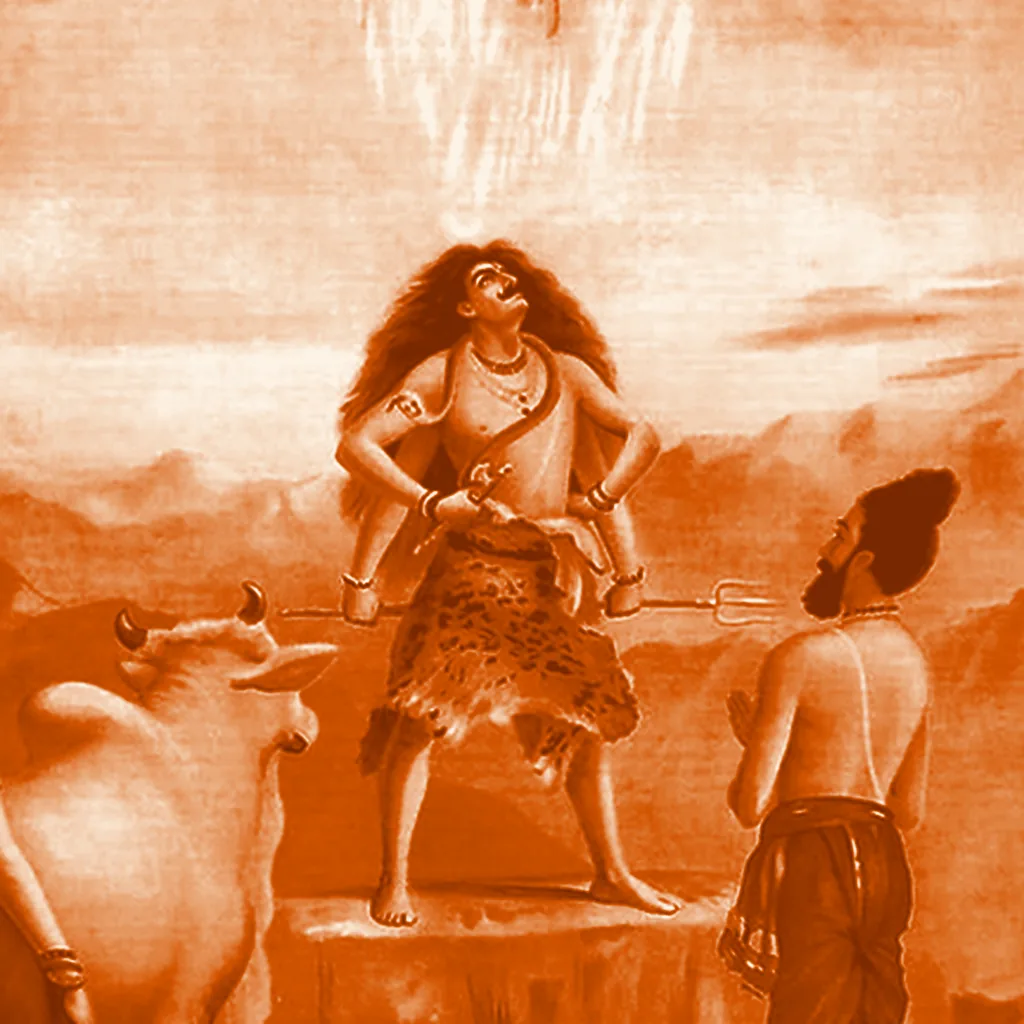
The Rudrashtakam, also written Rudrashtak or Shiv Rudrashtakam, is the hymn of eight verses to Lord Shiva that begins Namami Shamishan Nirvana Rupam. Goswami Tulsidas composed it in Sanskrit and placed it in the Uttarkand of Shri Ramcharitmanas, and for four centuries it has been one of the most recited Shiva hymns in North India, on Mondays, through the month of Shravan and at Mahashivratri.
This page gives the complete text, the eight verses and the closing verse, each with a plain meaning in English, followed by where the hymn comes from, what it asks for, and how it is recited. The same nine, the eight verses and the closing one, are the answers of the Shiv Prashnavali on this site, where a number you choose leads to one of them.
The Eight Verses and the Closing Verse, with Meaning
Verse 1
I bow to the Lord, the ruler of the north-east, the very form of liberation, all-pervading, the Brahman the Vedas speak of. Resting in himself, beyond qualities and divisions, desiring nothing, the sky of consciousness clothed in the sky itself: him I worship.
Verse 2
निराकारमोंकारमूलम् तुरीयम्। गिराज्ञानगोतीतमीशम् गिरीशम्।
करालम् महाकालकालम् कृपालम्। गुणागारसंसारपारम् नतोऽहम्॥२॥
करालम् महाकालकालम् कृपालम्। गुणागारसंसारपारम् नतोऽहम्॥२॥
Formless, the root of Om, the fourth state beyond waking, dream and sleep; beyond speech, knowledge and the senses; lord of the mountain. Fierce, the death of death itself, and yet compassionate; the home of every virtue, beyond this world: to him I bow.
Verse 3
तुषाराद्रिसंकाशगौरम् गभीरम्। मनोभूतकोटि प्रभाश्रीशरीरम्।
स्फुरन्मौलि कल्लोलिनी चारुगंगा। लसद्भालबालेन्दु कण्ठे भुजंगा॥३॥
स्फुरन्मौलि कल्लोलिनी चारुगंगा। लसद्भालबालेन्दु कण्ठे भुजंगा॥३॥
White as the snow mountain and deep as the sea; a body radiant beyond ten million gods of love. The lovely Ganga leaps in his matted hair, the young moon shines on his brow, and a serpent rests at his throat.
Verse 4
चलत्कुण्डलम् भ्रूसुनेत्रम् विशालम्। प्रसन्नाननम् नीलकण्ठम् दयालम्।
मृगाधीश चर्माम्बरम् मुण्डमालम्। प्रियम् शंकरम् सर्वनाथम् भजामि॥४॥
मृगाधीश चर्माम्बरम् मुण्डमालम्। प्रियम् शंकरम् सर्वनाथम् भजामि॥४॥
Earrings swinging, fine brows and wide eyes, a cheerful face, a blue throat, and kind. Clothed in the lion's skin, wearing a garland of skulls: the beloved Shankar, lord of all, I worship.
Verse 5
प्रचण्डम् प्रकृष्टम् प्रगल्भम् परेशम्। अखण्डम् अजम् भानुकोटिप्रकाशम्।
त्रयः शूलनिर्मूलनम् शूलपाणिम्। भजेऽहम् भवानीपतिम् भावगम्यम्॥५॥
त्रयः शूलनिर्मूलनम् शूलपाणिम्। भजेऽहम् भवानीपतिम् भावगम्यम्॥५॥
Fierce, supreme, bold, the highest lord; undivided, unborn, bright as ten million suns. With the trident in his hand he uproots the three sorrows. Husband of Bhavani, reached only through love: him I worship.
Verse 6
कलातीत कल्याण कल्पान्तकारी। सदा सज्जनानन्ददाता पुरारि।
चिदानन्द सन्दोह मोहापहारि। प्रसीद प्रसीद प्रभो मन्मथारि॥६॥
चिदानन्द सन्दोह मोहापहारि। प्रसीद प्रसीद प्रभो मन्मथारि॥६॥
Beyond the divisions of time, all-auspicious, the one who ends the age; the constant giver of joy to the good, destroyer of the three cities. Mass of consciousness and bliss, remover of delusion: be pleased, be pleased, Lord, conqueror of desire.
Verse 7
न यावद् उमानाथपादारविन्दम्। भजन्तीह लोके परे वा नराणाम्।
न तावत्सुखम् शान्ति सन्तापनाशम्। प्रसीद प्रभो सर्वभूताधिवासम्॥७॥
न तावत्सुखम् शान्ति सन्तापनाशम्। प्रसीद प्रभो सर्वभूताधिवासम्॥७॥
As long as people do not worship the lotus feet of Uma's lord, there is no happiness and no peace for them, in this world or the next, and no end to their burning. Be pleased, Lord, you who dwell in every living being.
Verse 8
न जानामि योगम् जपम् नैव पूजाम्। नतोऽहम् सदा सर्वदा शम्भु तुभ्यम्।
जराजन्मदुःखौघ तातप्यमानम्। प्रभो पाहि आपन्नमामीश शम्भो॥८॥
जराजन्मदुःखौघ तातप्यमानम्। प्रभो पाहि आपन्नमामीश शम्भो॥८॥
I know no yoga, no japa, no worship. I only bow to you, Shambhu, always and in every way. Burning in the flood of birth, old age and sorrow, protect me, Lord; I come to you in distress.
Closing verse
रुद्राष्टकमिदम् प्रोक्तम् विप्रेण हरतोषये।
ये पठन्ति नरा भक्त्या तेषाम् शम्भुः प्रसीदति॥
ये पठन्ति नरा भक्त्या तेषाम् शम्भुः प्रसीदति॥
This hymn of eight verses to Rudra was spoken by the brahmin to please Hara. Those who recite it with devotion, with them Shambhu is pleased.
Where the Rudrashtakam Comes From
Tulsidas places the hymn in the Uttarkand of Shri Ramcharitmanas, inside the story of Kakbhushundi. In an earlier birth Kakbhushundi was a devotee of Shiva who slighted his own guru inside a Shiva temple, and Shiva cursed him for it. The guru, a brahmin, then prayed to Shiva to soften the curse, and the Rudrashtakam is that prayer. Its closing verse says so in one line: this hymn was spoken by the brahmin to please Hara.
The eight verses are in the Bhujangaprayata metre, four parts of twelve syllables each, which gives the hymn the rolling rhythm that makes it easy to sing and to remember. The ninth verse, the phalashruti, is in the simpler shloka metre and states the fruit of recitation.
What the Hymn Asks For
The first six verses are praise. They describe Shiva as beyond form and qualities, as the death of death itself and yet compassionate, as the one with the Ganga in his hair and the moon on his brow, and as the one who uproots the three sorrows, the pains that come from the body, from other beings and from fate.
The seventh verse turns to the listener: until a person worships the lotus feet of Uma's lord, there is no peace here or hereafter. The eighth is the devotee's own voice: I know no yoga, no japa, no worship, I only bow to you; burning in the flood of birth, age and sorrow, protect me. That movement, from praise to plea to surrender, is why the hymn is sung in distress as much as in celebration.
When and How It Is Recited
There is no restriction of day or person. By custom it is recited on Mondays, on the Mondays of Shravan, on Pradosh evenings and on Mahashivratri, in the morning after bathing or in the evening at the lamp, facing a Shivling or an image of Shiva. Many devotees offer water or bilva leaves first and recite the hymn once; some recite it eleven times.
The closing verse promises only this: Shambhu is pleased with those who recite it with devotion. Recite it slowly enough to follow the meaning, and the meaning will carry you through the Sanskrit.
Frequently Asked Questions
Who wrote the Rudrashtakam?
Goswami Tulsidas, the author of Shri Ramcharitmanas, composed it in Sanskrit and placed it in the Uttarkand of that work.
How many verses does the Rudrashtakam have?
Eight verses, which is what ashtakam means, plus a closing verse that states the fruit of recitation, nine in all.
Is the Rudrashtakam part of the Ramcharitmanas?
Yes. It appears in the Uttarkand, in the story of Kakbhushundi, where a brahmin guru sings it to Shiva to soften a curse laid on his disciple.
Can the Rudrashtakam be recited daily?
Yes. It is short, takes a few minutes, and the text sets no condition other than devotion. Mondays, Shravan and Mahashivratri are the customary occasions.
What does Namami Shamishan Nirvana Rupam mean?
I bow to the Lord, the ruler of the north-east, the very form of liberation. It is the opening of the first verse, which goes on to describe Shiva as all-pervading, beyond qualities, and clothed in the sky itself.
If you have come to the Rudrashtakam with a question of your own, the Shiv Prashnavali on this site lets you choose a number and read one of these nine as your answer, with its meaning and a reading of whether the matter is favourable.
The verses are traditional texts; the explanations are the site's own words, offered for reflection, not as a guarantee of any outcome. Privacy Policy.
Image: Raja Ravi Varma, The Descent of Ganga (public domain), recoloured in the site's palette.